
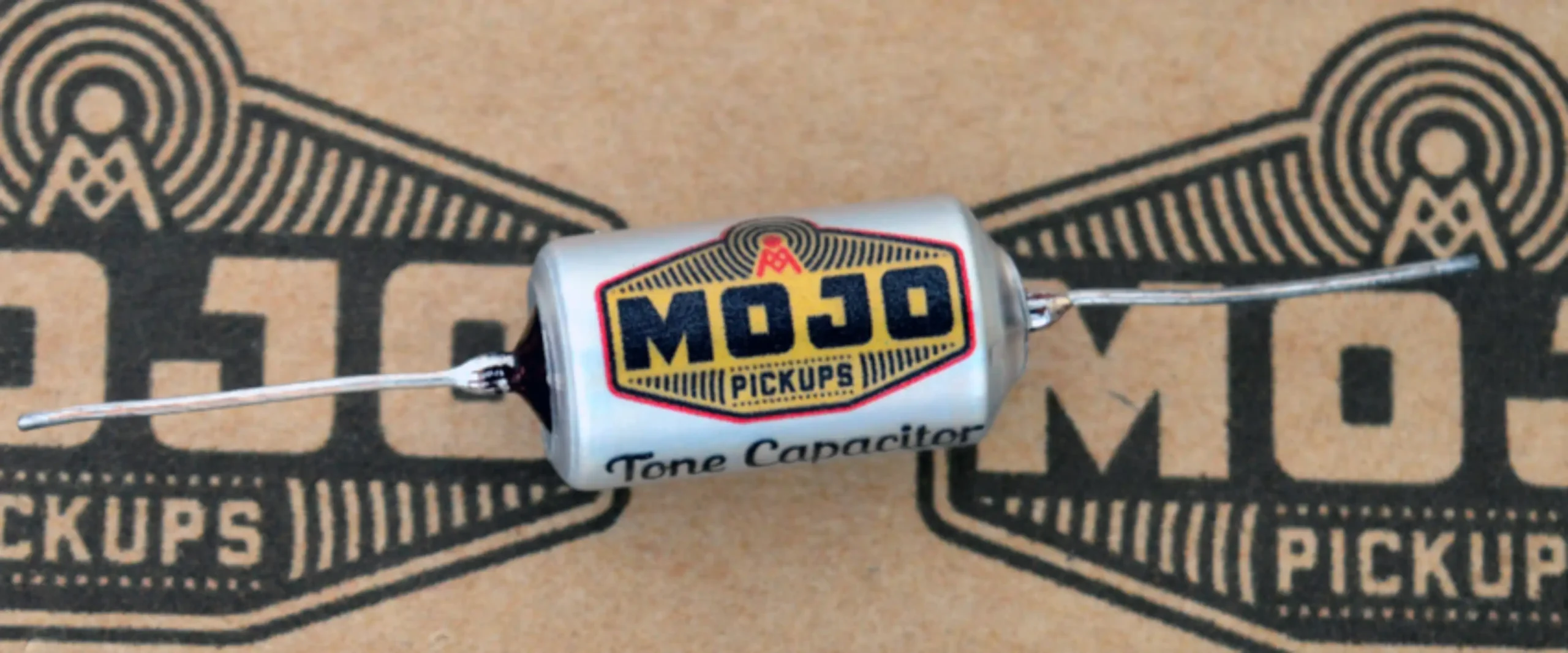
So, you’ve just levelled up your tone with a set of hand-wound Mojo Pickups. Whether it’s our vintage-spec Gold Foils, a punchy set of Broadcasters, or our legendary Wide Range Humbuckers, you’ve got the engine—now you need the right plumbing.
Wiring your guitar isn’t just about making a connection; it’s about fine-tuning the frequency response. Here’s how to choose the right pots and caps to ensure your Mojo sounds exactly as it was intended straight out of our Yorkshire workshop.
1. Potentiometers: The Gatekeepers of Tone
The resistance of your pots (measured in “k” for Kohms) dictates how much high-end “shimmer” stays in your signal.
250k: The Single Coil Soulmate
Recommended for our Mojo Strat, Tele, and Broadcaster sets. Single coils are naturally bright; 250k pots help smooth out the top end so it’s sweet rather than shrill.
500k: The Humbucker & P90 Standard
Essential for Mojo Humbuckers and P90s. These pickups have more internal resistance and a darker profile. 500k pots keep the “mud” at bay and ensure your humbuckers have that classic clarity and “bloom.”
1 Meg: The Jazzmaster & Wide Range Special
If you’re installing our Mojo Wide Range Humbuckers or Jazzmaster pickups, 1 Meg pots are the traditional choice. They allow the maximum amount of treble through, giving you that iconic, wide-open “chime” that defines those guitars. If your Jazzmaster is too bright, consider switching to 500K.
Mojo Tip: We always recommend CTS Pots. They are the industry standard for a reason—reliable, durable, and they have the “feel” a premium guitar deserves.
2. Capacitors: Shaping the Roll-off
The capacitor (cap) works with your tone pot to decide which frequencies get sent to ground when you roll back.
-
.047µF: Found in most Telecasters and Strats. It offers a deeper, darker roll-off. Perfect if you want to turn your bridge pickup into a warm, jazz-ready tone.
-
.022µF: The most versatile cap. We recommend this for Mojo Humbuckers, P90s, and Gold Foils. It provides a musical, usable sweep that takes the edge off without getting too “woolly.”
-
.015µF: A “boutique” secret. Great for the neck position of a humbucker-equipped guitar. It keeps the neck pickup clear and articulate even when the tone is rolled halfway down.
3. The Mojo Pairing Guide
Different pickups have different personalities. Use this table to find the right electronics for your specific Mojo set.
4. Vintage vs. Modern Wiring
Since you’re going for that Mojo vibe, how you wire the pots together matters as much as the values themselves.
’50s Style (The Mojo Choice)
We’re big fans of ’50s wiring. By connecting the tone pot to the output of the volume pot (rather than the input), you keep your treble intact as you turn the volume down. It makes your guitar feel more “alive” and interactive. You won’t need a treble bleed circuit with this setup.
Modern Wiring
Standard on most factory guitars today. It’s consistent, but as you roll the volume down, the tone can get a bit darker. If you prefer this, consider adding a Treble Bleed to maintain clarity.
Personally, I’m not a huge fan of treble bleed, but there are plenty of good guides out there for you to follow.
5. Don’t Skimp on the Details
You wouldn’t put budget tyres on a supercar. When installing Mojo Pickups, we recommend using high-quality internal components to finish the job:
-
Cloth-covered wire: For that authentic vintage look and easy lead dress.
-
Switchcraft Jacks & Toggles: The only way to ensure your signal path is rock solid.
- CTS Pots: If you can find the “True Vintage Taper”, in my opinion, these are best.
-
Paper-in-Oil (PIO) Caps: If you want the ultimate vintage response and a smooth tone taper.